

A Collective Approach to Care
Thinking about well-being through a collective approach to care first requires questioning the idea that it is solely a personal, intimate, almost solitary journey. As if caring for oneself were primarily an individual responsibility. Yet certain life situations challenge this perspective, such as grief, aging, illness, or simply periods of fatigue, transition, or overload that anyone may experience throughout their life. When challenges accumulate, when the pace intensifies, or when we move through demanding periods, the presence of a community can become decisive. This approach resonates deeply with Le Monastère des Augustines, which has been working for more than ten years to offer restorative experiences to the broader population.
Should we rethink well-being? No longer as something one must carry alone, but as an experience supported by environments and spaces that care for people? What if well-being were the responsibility of an entire collective?

Community: A Lever for Well-Being
A community offers a space where we can be as we are, without needing to explain, justify, or perform. A place where simply being surrounded by people who share a similar reality can make a difference. This sense of belonging and recognition is beneficial both for those engaged in caregiving roles and for anyone going through a difficult time.
In fact, did you know that in Québec, more than one in five people serves as a caregiver? Behind this number lie demanding realities: weeks that stretch on, multiple responsibilities, and a constant emotional burden. On average, caregivers devote more than 30 hours per week to supporting a loved one, often while also managing work, family, and social life. In this context, isolation and exhaustion are not exceptions, but well-documented risks.
Rather than carrying fatigue, worry, or exhaustion alone, caregivers who benefit from a strong social network feel less isolated, more supported in their decisions, and better equipped to navigate everyday challenges. In other words, community provides concrete support for those facing difficult circumstances.
The Social Mission of Le Monastère des Augustines
Public health research confirms that social support plays a decisive role in reducing distress and sustaining the well-being of people in vulnerable situations, particularly caregivers and healthcare professionals.
The social mission of Le Monastère des Augustines naturally supports these individuals, because it rests on a simple and powerful conviction: it is essential to care for those who care for others. Inherited from the work of the Augustinian Sisters, this mission recognizes that care extends far beyond medical treatment; it encompasses listening, hospitality, presence, and human dignity.
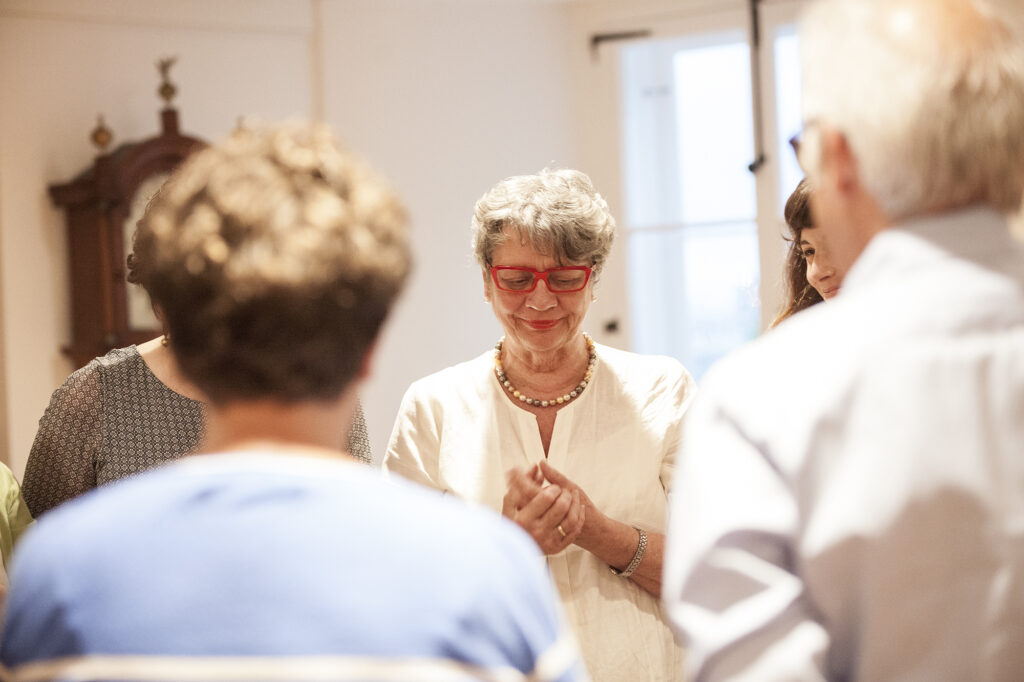
This mission is expressed through programs dedicated to caregivers, including individual and group respite stays, activities, accompaniment, and more. For healthcare professionals, it takes shape through group training, retreats, and preferential-rate stays.
By offering spaces for rest, silence, and renewal, Le Monastère addresses needs that are too often overlooked among caregivers and healthcare professionals: the need to breathe, to be recognized in a demanding role, and to have a place to release what feels heavy to carry. In this way, Le Monastère’s social mission serves as a lever for prevention and support, creating a safe environment where individuals can acknowledge their fatigue without guilt and regain the strength needed to continue their commitment with greater compassion toward themselves.
A Reality Supported by Research
The social mission of Le Monastère des Augustines finds direct and measurable resonance in the reality of those living through vulnerable circumstances. A research project123 conducted by the Relief Research Chair in Mental Health, Self-Management, and Work at Laval University and VITAM – Sustainable health research in Québec demonstrates that Le Monastère generates significant positive effects on participants’ overall well-being.
The research report highlights that the Le Monastère’s impact does not rely solely on rest or withdrawal from daily life, but on a holistic approach that includes:
- A heritage environment rich in meaning;
- Moments shared in community;
- The welcoming presence and compassion of staff, rooted in the values of the Augustinian Sisters.
Indeed, from the moment they arrive at Le Monastère, many participants describe an immediate sense of calm, a feeling of safety, and sometimes even the impression of being “held.” For many, being in a heritage space shaped by values of solidarity and care reinforces the sense that they are not alone in their commitment. The history of the place resonates with each person’s own story.

Collected data show that the community dimension contributes to a reduction in the subjective burden experienced by caregivers. In the short term, participants report increased vitality, improved self-care strategies, and a marked reduction in exhaustion, anxiety, and the weight associated with their role. Moreover, certain benefits, particularly those related to supportive relationships and reduced exhaustion, persist for up to three months after a stay at Le Monastère.
These effects are significant and especially valuable in lives often shaped by overload.
Caring: A Collective Act
Caring for a loved one is a deeply human commitment, often guided by love, loyalty, or a sense of duty. Yet this role can also be demanding, quiet, and sometimes difficult to carry alone. While we often speak of well-being as an individual journey, when caring for someone else, this perspective quickly reveals its limitations.
The social mission of Le Monastère des Augustines is rooted precisely in this broader vision of care. By offering time, space, and a meaningful community, Le Monastère helps restore breath, recognition, and dignity to anyone seeking sustainable well-being.
Ultimately, perhaps well-being is not only a personal pursuit, but a shared responsibility, one held by both organizations and individuals. A way for the collective to say to those who care for others: You are not alone.
SOURCES:
- Leblond, Y., Coulombe, S., & Dionne, E. (2025). Contribution du patrimoine culturel matériel et immatériel au bien-être durable: Une exploration centrée sur le potentiel psycho-environnemental au Monastère des Augustines. Chaire de recherche en santé mentale, autogestion et travail, Université Laval.
- Leblond, Y., Coulombe, S., & Dionne, E. (2025). Le patrimoine pour favoriser le répit en contexte de proche aidance? Chaire de recherche en santé mentale, autogestion et travail, Université Laval.
- Dionne, É., Coulombe, S., & Leblond, Y. (2025). Évaluation d’une intervention de promotion de la santé durable axée sur le répit et la quête de sens à travers l’interaction avec le patrimoine. Chaire de recherche en santé mentale, autogestion et travail, Université Laval.
- https://publications.msss.gouv.qc.ca/msss/fichiers/2021/21-835-11W.pdf?